
Having introduced the LCL shipping in last article,
Here we comes to FCL shipping, the most common used shipping method for global export & import business.
In this comprehensive guide, you will learn everything you need to know about fcl logisitcs.
In particular, the fcl shipping container transport from China.
So if you want to save time and efforts for your fcl shipment , you will love this guide.
Let’s dive right in.
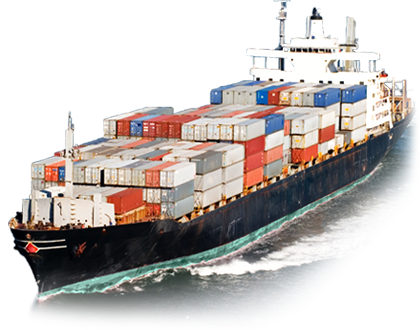
Without further ado, let’s kick things off with a chapter on the basics.
Specifically, in this chapter you will learn fcl meaning.
I’ll also show you the advantagess and disvantages of fcl.
What’s more, when to consider fcl based on comparison of fcl vs lcl.
Let’s get started.

What is FCL ?
FCL stands for full container load.
It describes cargo large enough to fill a full container when loading.
In practice, it means that the entire container is intended for one consignee.
Specifically, you don’t need to share container space with other importers like LCL.
You have the right to control the container when use FCL shipping service.
FCL container shipping is the most widely used modes of transportation among all the shipping methods.
At the same time, it is the most cost-effective solution.
The pros and cons of FCL shipping
FCL VS LCL
Advantages & Benefits
- Faster : FCL shipment don’t need devanning like LCL, which saves transit time during the transshipping.
- More Safe: You’re renting the entire container and you’re free to load the container what you like with it inside, means less handling and fewer risks of damage.
Disadvantages & Drawbacks
- Costly : Shipping larger volume and quantities means you need to buy more and pay more.
- Complicated : The whole process of FCL could be more complicated than LCL. You will need to know more knowledge to cope with the problems.

FCL VS AIR
Advantages and Benefits
- Load more : As you can image and see, a steamship can definitive have much more space than a airplane.
- Save cost: For big volume cargo, surely you will save a lot compared with using air service.
Disadvantages and Drawbacks
- Slower : Of course, vessel can’t be faster than plane. So FCL takes longer time.

When to book FCL shipment ?
As mentioned above pros and cons of FCL, you can choose FCL shipping when :
- Shipping Big volume ( Large than 10 CBM ) .Goods above this volume can be more competitive than LCL.
- When you need cargo more safety shipped, again, lower risk of damage during the devanning.
- When you need shipment arrive it time. FCL transit time could be more fixed than LCL.

What goods are not allowed by FCL?
Despite FCL is most used type of shipping, not all cargo can be shipped, especially the sensitive and dangerous cargo.
The list of prohibited or restricted goods potentially includes :
It doesn’t mean above cargo are 100% can’t be shipped, unless you meet the dangerous goods regulations.
- Ask supplier to offer MSDS, Chemical test report, DGM, UN 38.3 etc shipping documentation for verification before make the booking.
- Provide official statement and guarantee sheet that you’re in charge of all the risks

As you already know, FCL is full container load.
Now it is time to talk about things of container.
Specifically, I will show you 3 container types and dimensions, payload for each type of container.
It’s a very important knowleage you need to master.
With that, you can figure out how many cargo can be loaded and how many containers needed.
Keep reading.
The International Organization for Standardization (ISO) sets the standards for shipping container dimensions.
There are 3 kinds of standard containers : 20ft,40ft,40hq
| 20ft | 40ft | 40 High Cube | |
 |  |  | |
| Interior Dimensions ( M ) | |||
| Width Length Height | 2.35 5.896 2.385 | 2,35 12.035 2.385 | 2.35 12.035 2.697 |
| Tare Weight ( KG ) | 2300 kg | 3,700 kg | 3,800 kg |
| Cubic Capacity ( CBM ) | 33.0 cbm | 67.0 cbm | 76.0 cbm |
| Payload(KG) | 24,850 kg | 32,500 kg | 30,200 kg |
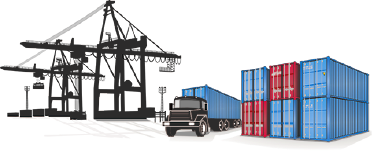 Despite the payload for 20ft is nearly 25 TON, and 28 TON for 40ft,
No shipping lines want to accept such heavy cargo any longer especially when the VGM policy came out.
Based on our operation experience, shipping line prefer cargo under 15 TON for 20ft and 20 TON for 40ft.
When overweight, special application is required.
And of course, addtional costs will be incurred.
 For FCL shipping, your pallets should ideally pack tightly into your shipping container.
Depending on pallet type ( Euro , North America and Standard ) and size,
the number of pallets you will be able to load into a 20-foot container or 40-foot container varies.
 Despite dimensions may vary slightly, even these numbers should be very close, the shipping capacity are all theoretical value.
Due to cargo are in different packings, and in different dimensions, final capacity will differ a lot.
In most cases, volume under 25 CBM is recommended to use a 20ft container.
And 50-55 CBM in practice for 40ft container.
How does it work by FCL ?
| Step | Description |
|---|---|
| 1.Loading | After space booked, forwarder sent a container from container yard to shipper factory or warehouse for loading |
| 2.Export Haulage | After container loaded, container sent back to the origin terminal |
| 3.Export Customs | Customs clearance in China with the necessary shipping documentation |
| 4.loading | Container load onboard and wait for release |
| 5.Shipping | The sea transport on sea ( Port to Port ) |
| 6.Unloading | Container will be discharged at destination terminal from vessel after arrival |
| 7.Import Customs | An import declaration is made at the destination container yard. |
| 8.Delivery | After Customs cleared, container will be delivered to consignee designated warehouse or place. |

How to book FCL shipments ?
Import and customs processes are complex.
Mistakes can be costly.
So having a shipping agent involved is an effective way of managing the risks and ensuring the process goes smoothly.
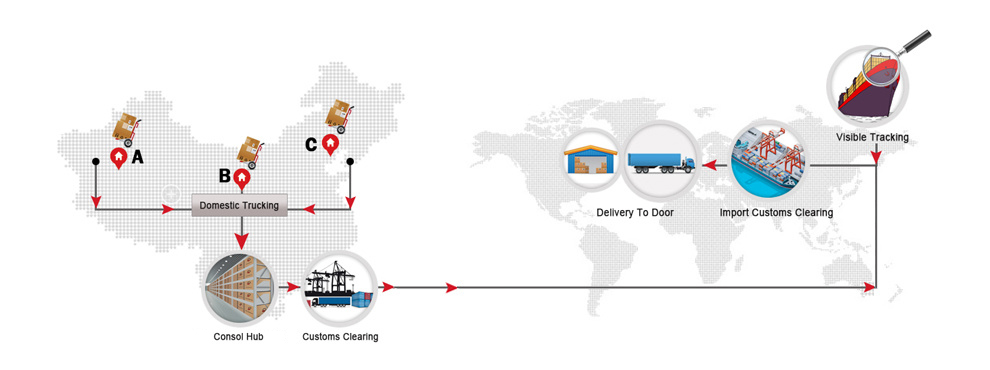
| Step | Description |
|---|---|
| 1.Inquiry | You find and choose a good China forwarder , send them shipment details and request for quotes. |
| 2.Quoting | Based on the freight requests, forwarder provide shipping proposal with time, schedule, price and suggestions. |
| 3.Booking | At this point, what you need to do is :
Forwarder contact suppliers to make the booking. |
| 4.Export Operation | It’s all about the basic work involved in getting a shipment out of China.
|
| 5.Shipping | The sea transport on sea ( Port to Port ) |
| 6.Payment | Your forwarder will send you the freight invoice. |
| 7.Tracking | Track your shipment online and get the real-time shipment status. |
| 8.After sale |
|
With the fcl proess flow, you now know how fcl works.
Still got questions ? Try FAQ.
With above shipping process flow, you now have a clear understanding of booking the FCL shipment.
Now here comes to the cost , I believe it is the most important part you care like all the importers.
In this chapter, you will learn everything you need to know close related to FCL shipping cost .
Specifically,
- How to calculate FCL shipping charge ?
- What’s the estimated container shipping cost from China ?
Let’s begin.
How to calculate by FCL shipping costs?
The weight and volume determin how many cargo can be loaded by a type of container.
It’s nothing to do with the container shipping cost.
Interpretation
- Cost is different for each type of container.
- The chargeable unit by FCL shipping is quantity.

For Example
If you book 4 x 20ft + 2 x 40ft + 1 x 40hq rom Shenzhen to Logostics,
When the quote is USD 850 / 1200 / 1250 per 20ft/40ft/40hq ,
Then total FCL shipping cost is 850 X 4 + 1200 X 2 + 1250 X 1 = USD 7050
What’s the FCL container shipping cost from China ?
Looking for estimated container shipping cost price from China ?
Use our free container shipping cost calculator to get instant rates from China to global countries major ports.
Just simply select destination country or input the discharge port you need to ship.

FAQ
 As you see, 20ft container is the smallest type of container.
So minimum order for FCL is 20ft container.
But how many CBM recommended to use 20 foot ?
Normally, if the volume above 10 CBM, FCL could be a good choice.
Otherwise, use LCL or Air service.
Despite there are no interval price like LCL or Air freight
You can still negotiate a discount with your forwarder.
For example, suppose you book 2 x 40ft from Qingdao to Sydney with a price of USD 1100/ 40FT.
When the amounts increased to 5 or 10 x 40ft containers, normally your designated forwarder can offer you a discrease of USD 50/ container.
Consequently, you can save USD 250-400 for this shipment.
 The answer is YES.
FCL container shipping price flutuate frequently.
An quote can’t be effective for too long, normally only can be used for 2 weeks, 1 month at most.
So in case you got a very cheap price compared with current market price, it may be truly exist, but few years ago.
Bottom line ?
Remember to cofirm the quote validity before booking.
The shipping cost are easily effected by seasons factor. July and August are the Peak Season, price are increased
And shipping costs will be increased before Chinese holiday like National Day, Chinese New Year.
After that, price tend to decrease.
 For international shipping, freight prepaid is requested according to common rules.
Despite payment can be made after vessel sailing, it must be received before goods arrived at destination port ( i.e, Before shipment released actually )
T/T ( Telegraphic Transfer) is the most used payment tool.
Money Gram/Western Union is no more accepted by China forwarders due to the bank regulation more strict.
Paypal can only be used to accept small amount under $ 1000.
For some regular and valued clients, FreightPaul can provide freight collect service.
What’s the breakdown of the shipping cost ?
Take notice that FCL is just port to port service, not door to door.
The whole FCL shipping costs are consists of 3 parts :
- Export charges in China
- Ocean Freight port to port
- Destination import fee
The given fcl shiping table price is just for cost of #2.
If you require door to door service, basic ocean freight charges #2 aside, the export charges in China #1 and import charges #3 must be consider when calculating your cost of import from China.
What’s more,
The fees and charges in an international shipping cost are wide-ranging.
They cover anywhere from port and custom charges to additional fees implemented only under very specific circumstances.
Most fees form part of the overall container shipping rates quoted by freight forwarders and carriers.
But there are some that aren’t included and may apply depending on your shipment.
To help with your understanding, we have categorized these fees into different sections.
Here’s a breakdown of whole FCL shipping charge.

| Charge Type | Chargeable Item | Mandatory | Explaination |
| Origin Charge | AMS/ACI/ENS | Each for US / Canada / Europe. It won’t be charged among other routes. | |
| VGM | √ | ||
| Overweight | If heavy conainer above 15 ton | ||
| Seal | √ | ||
| ISPS | √ | ||
| Overnight Fee | If delay loading for too much time | ||
| Picking up / Truck Delivery | √ | Optional: If required when EXW | |
| Export Customs Clearance | √ | ||
| Documentation / DOC | √ | It’s a B/L fee | |
| Customs Inspection | Optional: If happen | ||
| Cargo Insurance | Optional: If required | ||
| Certificate of Origin | Optional: If required | ||
| Handling | √ | ||
| Consolidation | If consolidate various shiopments | ||
| THC | √ | ||
| Port Charge | √ | ||
| Telex Release | √ | ||
| Booking | √ | ||
| Freight Charge | Sea shipping | √ | Port to Port |
| Fuel surcharge | Normally included in the A/F quote | ||
| EBS | Charged in certain season | ||
| CIC | Charged in certain routes | ||
| GRI | If happen | ||
| War Risks | For some routes | ||
| PCC | If vessel transit here | ||
| SUE | If vessel transit here | ||
| PSS | Charged in certain season | ||
| Destination Charge | Import Customs declaration | √ | |
| BAF | Charged in some routes | ||
| CAF | Charged in some routes | ||
| Pre-Pull | Most charged for shipments to US | ||
| Chassis | Most charged for shipments to US | ||
| Agency Fee | A import handling charge when deliver to door | ||
| ISF | For goods to US only | ||
| ISF Bond | For goods to US only | ||
| Customs Bond | For goods to US only | ||
| DTHC | √ | ||
| Delivery Order | √ | ||
| Container clearning | If happen | ||
| Pire Pass | For goods to US only | ||
| Congestion Surcharge | If happen | ||
| Customs Examination | For goods to US only | ||
| Deliver to door | √ | ||
| Tax & Duty | √ | ||
| Detention & Demurrage | If happen | ||
| Others | Storage | If required or if any delay happen | |
| Labelling | If required | ||
| Palleting | If required | ||
| Amazon reservation | For shipments to Amazon FBA | ||
| Amend / Switch B/L | If required |
- “√” means necessary charge.
- The origin charge in China will be paid by your supplier when Incoterm is FOB.
| Documents | Description | Who Need | Who Provide | Necessity |
|---|---|---|---|---|
| Bill of Lading | The most important document Identifies the shipper, consignee, and the types and quantity of the goods. | Destination Customs authorities and Customs broker | Shipping Line ( MBL ) Forwarder ( HBL ) | Necessary |
| Packing List | Identifies items, quantities, and includes the net and gross weight and dimensions of the packages . | Destination Customs authorities and Customs broker | * Your Chinese Supplier * Yourself if you are a middle man ( Use your own doc for blind shipping ) * Us forwarder ( Value added service especially for cargo consolidation ) | Necessary |
| Commercial Invoice | Lists the value of each item as well as the total value of the shipment. | Destination Customs authorities and Customs broker. | Same as Packing List | Necessary |
| Certificate of Origin | used to declare which country the shipment originated in. | Destination Customs authorities and Customs broker. | * Your Chinese Supplier * Or Your forwarder | Optional But recommended to reduce the import tariff |
| Insurance Policy | cover the loss of or damage to the cargo during transit. | You or final consignee | Your forwarder | Optional But recommended if the cargo value is high |
 Other documents may be required depending on the cargo itself and destination country.
Including :
- Dangersours Cargo ( MSDS , UN38.3, DGM, Chemical test report )
- Product certicate ( CCC, FDA, CE,etc )
- Invoice authentication ( Egypt )
- Form M ( Nigeria )
- Fumigation certificate for wooden packing to certain coutries like AU, US, etc
- … …
When forwarder ask the loading port and discharge port to quote,
Novice always answer like : ” Just give me the best price, no matter what the port is “
In fact, a veteran will give a accurate POL and POD.
They know it matters and can effect the shipping price a lot.
So, how is it like ?
Top 10 loading ports in China
Among the world’s top 10 ports in 2018, 7 of them are located in China.
No matter where your Chinese supplier located, your goods are never too far from one of the world’s largest and most productive ports.
You don’t have to pay much attention on the geographical location of your potential vendors in China.
But knowing a bit can help figure out the best POL ( Port of Loading ).
Top 10 ports in China
| Ocean Port | Volume 2018 (Million TEU) | Rank – China | Rank – Worldwide |
|---|---|---|---|
| Shanghai | 42.01 | 1 | 1 |
| Ningbo | 26.35 | 2 | 3 |
| Shenzhen | 25.74 | 3 | 4 |
| Guangzhou | 21.91 | 4 | 5 |
| Hong Kong | 19.60 | 5 | 7 |
| Qingdao | 19.31 | 6 | 8 |
| Tianjin | 16.01 | 7 | 9 |
| Kaohsiung | 10.45 | 8 | 14 |
| Xiamen | 10702 | 9 | 15 |
| Dalian | 9707 | 10 | 16 |

Which port do I need to ship ?
There are two criterias we normally use :
- Choose the closest port for main cargo.
Suppose you have two suppliers, one in Ningbo with 2 CBM, another in Shenzhen with 15 CBM.
Then the best way to consolidate the container is to deliver the goods in Ningbo to Shenzhen, load and ship the container from Shenzhen.
Don’t wrongly ship from Ningbo. The inland trucking delivery could be costly.
- Choose the main ports.
Taking one case in 2018,
A Dubai client need 18 x 40 HQ to Port Sudan, factory is Changzhou.
Despite there are barge service from Changzhou directly , we book the container from Shanghai.
Why ?
Main airports means more shipping companies with different routes, schedules and costs.
In short, more choice for you.
To help those importers who are new to international shipping,
we developed the featured World Seaports Location Finder.
You can search by port name, seaport code, or city and immediately be taken to the seaport on the map.
Clicking on the seaport will display specific information like port code, city, country & region, and other key points.
Looking to identify more ports in a specific area?
Just zoom in on a region or search for a specific city, state, or country to find their local seaports.
Pretty useful, right ?
People always ask where is my cargo.
Tracking is one of the most important part in shipping process.
Question is how ?
First, you need to know the shipping line name and tracking website
Second, get the container number or B/L no.
In this charpter, we will list the the common shipping lines and tracking websites.
Different shipping line have different price, service level and standards, schedules ( route &time ), etc.
So it is reasonable for you to learn a little about the shipping lines.
How to track the container ?
So now you have know which shipping line is transporting your cargo,
The next is to find the container number or bill number.
You can get both from the bill of lading.
Container Number is shown at the middle left of B/L.
And B/L no. is in the top right corner.
With that, you can get the orgin shipment status on shipping line’s system.

POL : Port of loading ; POD : Port of discharge.
Well, what’s the meaning of VGM ? What stands for WCA ? How much of THC cost ?
This chapter is about the shortened form of a word or phase.
And they are common used in international industry.
Here I have get it classified
Here is a glossary of shipping terminology for FCL shipping.
In case you are confused some other shipping words, you can further check the the comprehensive artilce of shipping abbreviation
CBM/M³ – Cubic Metres
Height×Width×Length to work out the cubic metre of a shipment
KG – Kilograms
LB – Pounds
CF – Cubic Feet
LF – Linear Feet
R/T – Revenue tonnes
A billing unit used in the international freight industry.
W/M – Weight or Measure
Billing will be based on whichever is greater based on the converstion factor
Refer to our Incoterms Page for a detailed explanation.

AMS – Amercian Maritime Security
Compliance costs associated with USA border security laws and procedures
BAF/BUC – Bunker Adjustment Factor / Bunker Charge
Fuel Surcharge on a shipping vessel. The BAF applies according to the number of TEUs shipped and is charged by the shipping companies to compensate for fluctuations in fuel prices. This surcharge varies from route to route.
EBS-Emergency Bunker Surcharge
The EBS is similar to the BAF in the sense that it covers rise in fuel prices. The EBS can also vary according to the shipping container type and shipping route.
CAF – Currency Adjustment Factor
Charged to cover currency fluctuation.It typically applies when there are significant fluctuations in exchange rates and is charged as a percentage of the ocean freight rate.
CABAF – CAF and BAF charges combined
FAF – Fuel Adjustment Factor
Fuel charges on road units or on airfreight
GRI – General Rate Increase
Used by shipping lines to label general increase in ocean freight rates on particular trade routes
ISPS – International Ship & Port Facility Security
To cover security handling at the origin and destination ports/depots
SCA – Sea Cargo Automation Fee
Applied by Australian Customs to the computer system that coordinates and controls the reporting and delivery of import sea-cargo in Australia
AI-All Inclusive
The total price to move cargo from point of origin to destination (transportation costs only)
BL Fee-Bill of Lading Fee
The shipping line charges this fee for processing the bill of lading on behalf of their client.
CBP-Customs and Border Protection
This the duty and associated processing fee when shipping goods from one country to another.
CYRC/CYC: Container Yard Receiving Charge / Container Yard Charge
It’s a terminal handling charge. This fee is payable to a shipping line for receiving a full container load, storing it, and delivering it. Delivery is to the ship at the port origin or it is to the consignee at the destination port.
DDC-Destination Delivery Charge
This charge is based on container size. It is applied in many tariffs to cargo as an accessorial charge on base ocean freight. It covers crane lifts off the vessel as well as drayage of the container and gate fees at the terminal.
THC-Terminal Handling Charge
Terminal handling charges apply to origin . It’s charged to FCL shipments to cover the container handling cost at the shipping terminal, including the loading and unloading of the container from the truck, as well as the transportation of the container to and from the vessel.
DTHC-Destination Terminal Handling Charge Fee
Charged by the port of arrival or port of discharge to lift the container onto or off the vessel.
EIS-Equipment Imbalance Surcharge
A surcharge imposed by shipping lines, at times, for the movement of large quantities of empty containers. A lack of export activity from the country where they were shipped full typically creates the need to do so. This is a flat rate per container when it is charged.
ERR: Emergency Rate Restoration
A surcharge added to the cost of freight to cover increases in shipping costs.
ERS: Equipment Repositioning Surcharge
This fee is imposed for the movement of empty containers from one location to another when requested by a shipper.
ISF: Importer Security Filing
A US Customs and Border Protection (CBP) regulation requiring importers and vessel carriers to provide data electronically to CBP for in-bound ocean shipments.
GAS: Gulf of Aden Surcharge
Compensates shipping lines for additional costs incurred due to transit through the Gulf of Aden.
OWS/OWC: Overweight Surcharge / Overweight Charge
It is a fee charged by shipping lines when each container exceeds the designated acceptable weight range for its size.
SCS: Suez Canal Surcharge
Compensates shipping companies for additional costs incurred during transit through the Suez Canal
SES: Special Equipment Surcharge
Seldom use it
PSS-Peak Season Surcharge
Carriers implement PSS during the shipping peak season (between July and October) to cover the increase in operational costs.
This can greatly increase your overall international shipping costs as carriers are already charging higher freight rates during this peak period.
The PSS is limited to and applied during the shipping peak season.
PRE-PULL
A pre-pull fee is charged when an empty container picked up from the port early and stored at a yard in order to meet a specific loading schedule the following day. This is usually the case for cargo that needs to be loaded onto a container on very tight loading times or dates.
VGM-Verified Gross Mass
This fee is charged by accredited facilities licensed to weigh shipping containers to comply with SOLAS regulations requiring all containers loaded on shipping vessels to have their gross weight declared.
20FT, 20′, TEU – Standard 20 foot shipping container
40FT, 20′, FEU – Standard 40 foot shipping container
FR – Flat Racks
HC – High Cube container
OT – Open top container
RF/Reefer – Refrigerated Container
B/B, B/Bulk – Break-Bulk
A large shipment, usually too big for a shipping container, that can be loaded directly onto a ship
DG – Dangerous Goods
Goods that could be harmfully to people and the enviroment and may require special handling
FAK – Freight All Kind
Full container load with a combination of freight from different shippers
FCL – Full Container Load
For higher volume shipments at least over 15 cubic metres total
LCL – Less than Container Load
For smaller sea freight shipments that do not require a full container. Minimum shipment size is 1 cubic metre (CBM/M³) to 1 tonne
LSE – Loose Airfreight
Goods travelling by airfreight on its own and not in a consolidation with other freight
LO LO – Lift on Lift off
Term used by carriers when shipping containers are lifed off the vessel (import) or forwarders truck (export) onto the forwarders truck (import) or vessel (export)
GP – General Purpose Container
Otherwise known as a standard container
OOG – Out Of Gauge
When your shipment over hangs the dimensions of a shipping container
RO RO – Roll On Roll Off
When a shipment can either be driven or towed on and off a vessel
SOC – Shipper Owned Container
Shipping container owned by the shipper rather than the shippng line
1.Plan the shipment in advance
Plan ahead means you will have enough time to find a good freight forwarder , secure the booking and deliver in time.
The risks of Customs inspection for a hurry shipment are higher.
More delays of shipping could be occured in the holiday season like Chinese new year.
Meanwhile, container shipping cost can be higher in order to confirm the space.
By planning ahead, you can not only avoid overpaying, but also take advantage of some nice discounts.
Always remember to leave extra time and book early.
2.Get container shipment well packed and insurance covered
All can nothing if without shipping safety.
Despite the risks of FCL is less than LCL, it still exists. After all, container takes a long journey on sea.
To avoid the damage, ensure your goods has a properly packing.
Cargo better be palletized or wrapped well.
Besides, buy the freight insurance for your cargo if it is valuable.
3.Consolidate the shipments and ship goods together
If you have various shipments from different suppliers,
Don’t ship separately by LCL service, but consolidate to ship together with one full container.
CONCLUSION
That’s all for my guide to fcl shipping.
It cover 80% topic of the whole indutry. Of courese, I will keep updating.
Now I’d like to hear from you:
Do you know the meaning of D/O ?
What tip from this guide do you want to try out first?
And are you going to consolidate your shipments?
Or maybe you want to designate shipping line MSC.
Either way, let me know by leaving a comment.
Leave A Comment